





















The world contains many beautiful sights and destinations, some more eye-catching than others, even when the reason is unclear. From ancient to new, this is exactly how we describe the 7 Wonders of the World—they leave us to wonder, “How are these things possible?”
However, this idea is not new and is definitely not random. For instance, scalarchives.com states, “The concept of ‘wonders of the world’ has been passed down through the centuries: from the philosophers of the Middle Ages, through the explorers of the modern era, to the scholars of the 19th century.” Over time, archaeological breakthroughs and geographical explorations have led to captivating reconstructions of the present and ancient world. But, in 2000, the New7Wonders Foundation, a Switzerland-based organization, launched a campaign to create a new list of wonders. It received over 100 million votes, introducing the names of the new seven wonders.
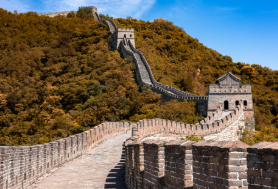
The Great Wall of China, located in Beijing, China, is the largest man-made structure in the world, spanning over 13,000 miles long. Qin Shi Huang—the first emperor of the Qin dynasty—commenced this major construction around 221-220 B.C. It served as a major defense system to protect states, empires, and trade routes, such as the Silk Road, from northern invasions. Furthermore, unesco.org explains, “It provides significant physical evidence of the far-sighted political strategic thinking and mighty military and national defence forces of central empires in ancient China, and is an outstanding example of the superb military architecture, technology and art of ancient China.” The Great Wall attracts some 10 million people every year and remains one of China’s greatest cultural symbols.
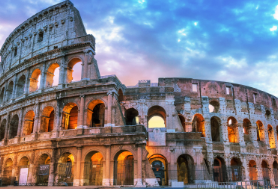
The Colosseum, also known as the Flavian Amphitheatre, has been Rome’s top attraction for many years. In the first century, around 70 A.D, it was built by Emperor Vespasian and was completed during the reign of his successor, Emperor Titus. Spanning 620 by 513 feet and nearly 160 feet high, the Colosseum embodies the grandeur of the Roman Empire. Back then, it could hold up to 50,000 people at once. It was there for those who wanted to see all sorts of entertainment, including gladiator battles. Most importantly, the building is renowned for its intricate engineering, including elevated arches and underground rooms.
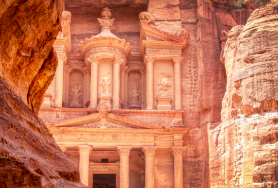
Petra is an ancient city and archaeological site in southern Jordan. It is famous for its architecture, half-built and half-carved into rocks, blending Hellenistic culture and eastern traditions to create a unique artistic achievement. Its most famous building, the treasury, is built directly into the cliffside and is surrounded by mountains filled with numerous gorges and passages. Petra is home to many temples and tombs, and historians estimate its creation around the 4th century B.C.E.
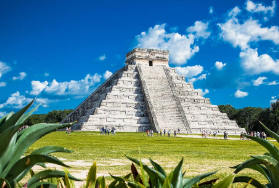
Chichén Itzá, located in Yucatán, Mexico, is home not just to one building but to an entire ancient Mayan city. The construction around 600 BCE dates back to pre-Hispanic America. One of its most well-known surviving buildings, the El Castillo, also known as the Temple of Kukulkan, has stood for about 1,000 years. It is a step pyramid and the tallest building that dominates the center of the archaeological site, standing at 98 feet tall. At the time, the building and its surrounding areas were central to Mayan commerce. Other notable structures include the Temple of Warriors, the ball court, and the Caracol, an astronomical observatory for the Maya. The site is open for those who want to learn more and explore Mayan culture and heritage.
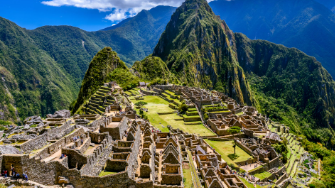
Located in Peru, Machu Picchu is an ancient Incan city built in the Andes Mountains above the Urubamba River. Built around 1450 BCE and later abandoned, the city remained hidden until 1911, when American explorer Hiram Bingham discovered it. The Incas most likely used it for government and religious purposes. The site encompasses over 200 buildings and remains one of the most popular tourist attractions, despite its arduous journey to the rocky edge at 2400 meters (7,874 ft).
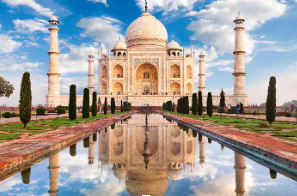
In Agra, India, on the banks of the Yamuna River, stands the Taj Mahal. Commissioned in 1632 as a mausoleum in memory of Mughal Emperor Shah Jahan’s wife. For over 300 years, it has stood as a symbol of peace, love, and eternal devotion. It is made of white marble and is renowned for its intricate carved details and complex mosaics; it is one of the greatest architectural achievements of Indo-Islamic architecture.
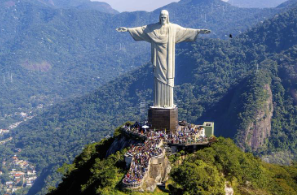
Finally, standing at 98 ft tall on the Corcovado Mountain in Rio De Janeiro, Brazil, is Christ the Redeemer. The Art Deco statue of Jesus was under construction from 1922 until its completion in 1931 to celebrate Brazil’s independence centenary; a major national celebration in 1922 for the 100th anniversary of Brazil’s independence from Portugal in 1822. Created by French-Polish sculptor Paul Landowski and built by Brazilian engineer Heitor da Silva Costa, it serves as a place of worship for believers. After 93 years, it remains a key cultural icon for the country of Brazil and the Rio de Janeiro landscape.
Currently, high demand from other sites to become the eighth wonder is appearing. From Asia to the United States, history.com lists some of those sites, “1. Pink and White Terraces, New Zealand,” or even “5. Angkor Wat, Cambodia.” For something to be considered a wonder, it must be an iconic, natural or human built site that exhibits immense scale and artistic/architectural value. So, at the end of the day, whether ancient or new, these landmarks and cultural icons represent humanity’s greatest achievements in engineering, perseverance, and artistic ambition.