




March Madness is a single-elimination college basketball tournament consisting of 68 Division 1 teams. Every year, fans anticipate incredible upsets and jaw-dropping finishes to nearly every game. Future NBA talent goes on full display during the tournament with a plethora of mind-blowing performances, as well as improbable buzzer beaters. March Madness 2026 was nothing short of amazing, and a majority of college basketball fans would agree.
The First Four is a set of games that occur before the actual tournament begins. These games determine which teams will not have the opportunity to participate in the tournament by gathering eight of the lowest-seeded teams at the end of the regular season and having them play each other based on the region (East, West, Midwest, South) they are in. Many Cinderella runs come from this round. A Cinderella run in March Madness is when a low-seeded team advances deep into the tournament, as if it were a Cinderella story going from rags to riches.
In this play-in round of the tournament, Miami (Ohio) earned its first March Madness win since 1999, led by Eian Elmer and Luke Skaljac, and Prairie View A&M earned its first tournament win ever, led by Dontae Horn and Cory Wells. Overall, the First Four wasn’t very interesting, with the most exciting games still ending in double-digit deficits, but the First Round tells a different story.
There were many thrillers in the first round of the tournament, but some stood out from all the others. The first game was a matchup between the High Point University Panthers (12th) and the Wisconsin Badgers (5th). Down the stretch, Nick Boyd was carrying Wisconsin’s offense, finishing the game with 27 points alongside his teammate, John Blackwell, with 22 points. However, on the other side, High Point had its dynamic duo of Rob Martin and Chase Johnston. Martin was on a heater throughout the game, finishing with 23 points and 10 assists, but towards the end, Johnston hit three three-pointers and the game-winning layup. The layup made by Johnston was his first two-point field goal of the season, making the shot even more special. According to ESPN, Chase Johnston said about the last play of the game, “I wasn’t really thinking whether it was a 2 or a 3, I was just trying to put it in and win the game.”
Another first-round nail-biter was surprisingly between the Duke Blue Devils (1st) and the Siena Saints (16th). Duke was the heavy favorite in this matchup, considering they were the 1-seed led by Cameron and Cayden Boozer, the twins of NBA legend Carlos Boozer. However, the Saints did not let that faze them. Siena’s starting lineup played the whole game except Brendan Coyle, who checked out of the game for 10 seconds. Siena led Duke at halftime by 11 points, but the Blue Devils were able to crawl back and secure the win 71-65. The Duke-Siena game was likely the most unexpected close matchup in all of the tournament.
The 7th-seeded Kentucky Wildcats versus the 10th-seeded Santa Clara Broncos was the definition of a close game. As time was winding down, and the Broncos and Wildcats were tied 70-70, Santa Clara’s power forward, Allen Graves, nailed a shot from deep to put the Broncos up 73-70 with just 2.4 seconds remaining. Luckily, Otega Oweh of the Wildcats was able to answer back in a legendary fashion, hitting a shot from just inside the half-court to send the game to overtime. However, Oweh wasn’t done, as he knocked down two additional free throws in overtime to ice the game, topping off his 35-point masterclass. According to ESPN, Otega Oweh mentioned after the game, “It’s March, I feel like that’s just what happens. You know, it’s crazy.” Kentucky snagged the win in OT 89-84, advancing to the Second Round.
Speaking of the Second Round, many of the matchups in this stage of the tournament were cinema. There were a couple of upsets in this round, including games between Texas and Gonzaga, as well as between Florida and Iowa. Other wildly close face-offs were Nebraska against Vanderbilt and Saint John’s against Kansas.
The Texas Longhorns (11th) versus the Gonzaga Bulldogs (3rd) was a dominant matchup between Texas center Matas Vokietaitis and Gonzaga center Graham Ike. Ike led the Bulldogs with 25 points to combat Vokietaitis’s 17 points, but the X factor in this game was Jordan Pope of the Longhorns. With 17 points as well, Pope had a game high of three three-pointers, leading Texas to a 6-point win to upset the Bulldogs 74-68.
The Nebraska Cornhuskers (4th) versus the Vanderbilt Commodores (5th) came down to the wire. Nebraska was leading 39-32 at halftime, but the Commodores, behind Tyler Tanner’s 27-point performance, were able to come back, tying the game at 72 apiece. However, Braden Frager enabled his clutch gene and hit a layup to put the Cornhuskers up by 2 with just 2.2 seconds remaining. In an attempt to cap off his heroic night, Tyler Tanner launched a 60-foot heave from beyond half court. The ball hit the backboard, bounced off the front rim, and then back rim, and out. Tanner’s fire was put out, and Vanderbilt was eliminated. However, Nebraska made history with its first Sweet 16 appearance in school history. Actually, Nebraska got its first-ever March Madness win against Troy in the first round of the tournament.
The Florida Gators (1st) versus the Iowa Hawkeyes (9th) concluded in a textbook finish. The game remained close throughout, with Iowa leading the Gators by 2 points at the half, led by Bennett Stirtz and Tavion Banks. However, Thomas Haugh and Alex Condon helped the Gators crawl back and take the lead, 72-70. In clutch time, Stirtz passed up the ball in a play originally designed for him, and the ball went to Alvaro Folgueiras in the corner. With 4.5 seconds remaining, Folgueiras nailed the shot, giving Iowa the lead and sealing the game.
The Kansas Jayhawks (4th) versus the Saint John’s Red Storm (5th) was yet another close game. Zuby Ejiofor and Bryce Hopkins put the pressure on Kansas right from the start, and both of them ended with 18 points. At halftime, the Red Storm were leading 34-26, with Darryn Peterson of the Jayhawks trying his best to keep Kansas in the contest, ending the game with 21 points. Despite Kansas’s 16 turnovers and going down 14 at one point, they were still able to come back with help from Melvin Council Jr. down the stretch. With the game tied 65-65 and 14 seconds left, Dylan Darling seized his opportunity. Even though he hadn’t scored all game, Darling drove straight to the cup and finished a tough layup to give Saint John’s the lead at the buzzer, winning them the game.
The Sweet 16 was the stage of the tournament where fans would see whether favored teams would prevail or if Cinderella runs would continue. Purdue against Texas and Nebraska against Iowa were examples of these games. History was made in this round, and it truly surprised many fans.
The Purdue Boilermakers (2nd) versus the Texas Longhorns (11th) was a back-and-forth matchup between a heavy favorite and the lowest-seeded team remaining in the tournament. Jordan Pope and Tramon Mark were getting the Longhorn offense going early, but Trey Kaufman-Renn and Fletcher Loyer had other plans, as they led 39-35 heading into the half. However, after only a few minutes of the second half, tragedy struck for the Longhorns. Their primary offensive weapon, Tramon Mark, suffered an ankle injury after being fouled on a three-point attempt. Mark had to be checked out for examination at the 15:37 mark, leaving it up to Dailyn Swain and Jordan Pope to run Texas’s offense. With Matas Vokietaitis having an off-game (9 points in the game), there was presumably no hope for Texas. Fortunately, after just two minutes of game time, Tramon Mark subbed back into the game. Despite his ankle, Mark felt he had to come back, considering his team’s season was on the line.
As explained by Mark, “Just being a competitor wanting to play and wanting to advance for my teammates, wanting to keep this thing going.” With Mark out on the floor, Texas was able to take a four-point lead, 70-66, with 5 minutes left. Purdue wasn’t going out that easily, though, and Braden Smith knocked down some clutch free throws to tie up the game. After a quick run by the Boilermakers, Texas found itself down 77-74, needing a miracle to come out of the game victorious. Luckily, Dailyn Swain was that very miracle. A layup plus the foul gave Swain an additional free throw, allowing him to tie the game 77-77 with 11 seconds remaining. Out of a Purdue timeout, Braden Smith drove right to the rim, but missed the layup with just a second left. In Trey Kaufman-Renn’s mind, though, overtime wasn’t enough. He wanted the win right then and there. Using his body to push out his defender, Kaufman-Renn elevated for the go-ahead tip-in with 0.7 seconds left, which was not nearly enough time for the Longhorns to get a quality shot off. Purdue would be advancing to the Elite Eight, and Texas’s Cinderella run had come to an unfortunate end.
The Nebraska Cornhuskers (4th) versus the Iowa Hawkeyes (9th) was an electrifying clash between two teams coming off of phenomenal Second Round matchups. Pryce Sandfort single-handedly led Nebraska to an early 10-point lead, and throughout the entire game, Nebraska never looked back. Bennet Stirtz was the only player keeping Iowa in the game, and he ended with 20 points. That was until the game approached the end of the first half, which is when Cooper Koch and Tate Sage began to hit their shots, bringing Iowa within 3 to end the half off a buzzer beater from Sage. The Cornhuskers maintained their lead and were consistently making more shots than the Hawkeyes, but at around the 6-minute mark, something changed. It started with a three by Cooper Koch to tie the game at 62 a piece, but Sandfort answered back with a three of his own. A few plays later, Alvaro Folgueiras nailed a downtown shot to bring it back to even yet again. Then, for the first time in the entire game, Iowa took the lead off a Stirtz three-pointer. From there, the Hawkeyes just continued firing and hitting. Tate Sage was the next to hit a three-pointer, giving the Hawkeyes a six-point lead. Braden Frager of the Cornhuskers knocked in a three-pointer of his own, but the next play was truly the exclamation point of the game. Off a pass from Kael Combs, Folgueiras drove baseline and punched home a powerful poster dunk. After missing a shot on the other end, Nebraska was forced to foul, and the game was as good as gone for Nebraska. Iowa prevailed 77-71, and they made it to the Elite Eight for the first time in 39 years.
The Elite Eight did not consist of many great matchups, as many of the high-seeded teams dominated their opponents. Arizona blew out Purdue by 15 points behind Koa Peat and Ivan Kharchenkov, winning 79-64. Illinois won by 12 points against Iowa despite Bennet Stirtz’s 24 points, thanks to having two of the game’s top 3 leading scorers in Keaton Wagler (25 points) and Andrej Stojaković (17 points). Finally, to many fans, Michigan versus Tennessee wasn’t a game; it was an obliteration. Michigan made history with the biggest blowout in the Elite Eight since 1989, winning 95-62.
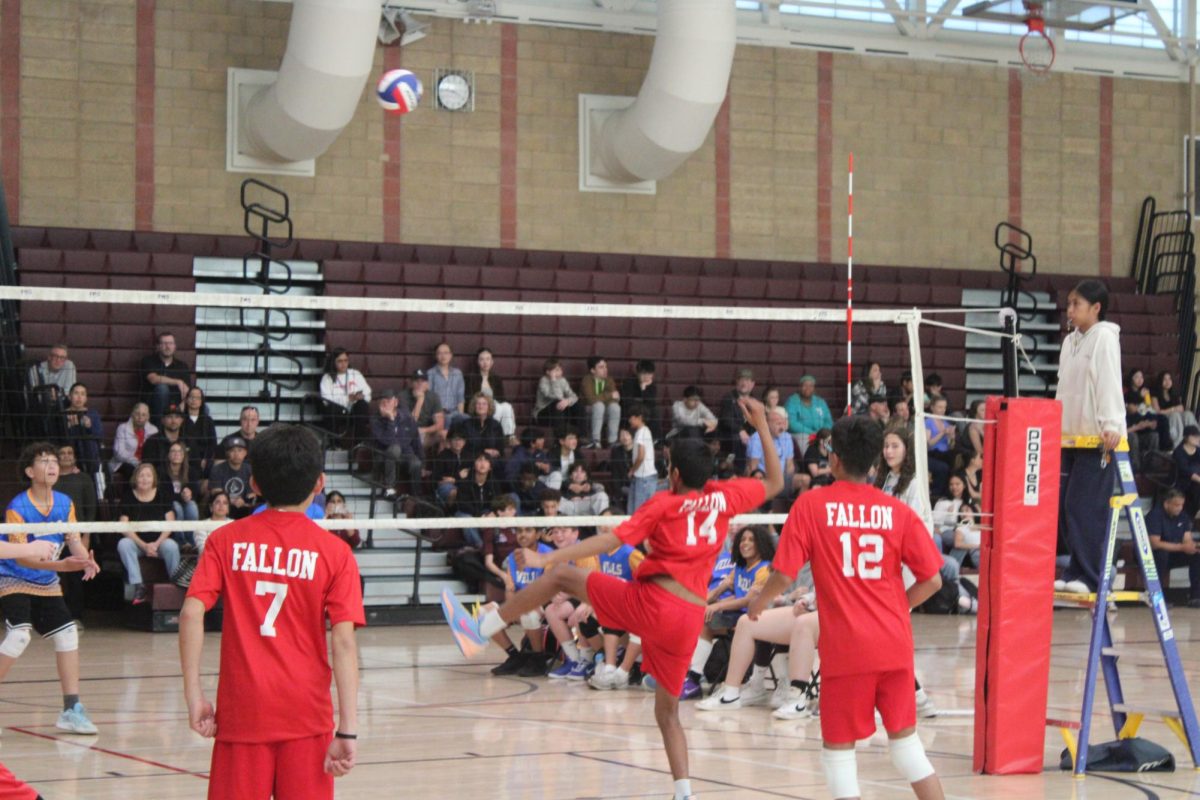
Unlike the other Elite Eight games, the Duke Blue Devils (1st) versus the UConn Huskies (2nd) was one of the greatest March Madness games in tournament history. The game was a war, and within it was a battle between Cameron Boozer of the Blue Devils and Tarris Reed Jr. of the Huskies. Both players led their teams in every major statistical category (points, rebounds, and assists), and they each had over 25 points on the night. However, Tarris Reed wasn’t enough in the first half, and the Huskies found themselves down 15 at halftime. At one point, they were down by as much as 19. For quite a while, UConn just couldn’t crack into Duke’s stable lead, but as time went on, the lead began to dwindle. The deficit continued to fluctuate, but in UConn’s favor. By the 12-minute mark, the Huskies got within 10 points, but as the clock ticked for the next few minutes, no progress was made. Despite the efforts of Solo Ball, Silas Demary Jr., and Alex Karaban in assisting Reed on the offensive end, nothing was working. That was until only five minutes were remaining. It started with a layup by Solo Ball to cut the lead to 7, and then a bucket by Tarris Reed, and then another layup by Ball. Just like that, the lead was down to just 3 points. Luckily for Duke, Cameron Boozer wasn’t done, and he started hitting clutch shots in the paint to continue extending Duke’s lead. With the score at 70-66, Duke in front, someone from UConn’s squad needed to do something. Alex Karaban heard the call and answered. A shot from 26 feet out brought it within one point. Cam Boozer drove and made a floater, making 72-69, but on the next play, Boozer fouled Silas Demary Jr., sending him to the line for two shots. Demary missed the first, but made the second, putting Duke in the perfect position to simply hold the ball since they were up by 2 points with just 10 seconds remaining. The ball was inbounded, and it was tossed ahead to Cayden Boozer near the half-court line. With 6 seconds left, Cayden tried launching a pass over two UConn defenders, but Braylon Mullins leaped and put his hands out as high as he could to steal the ball. He passed it ahead to Karaban, one of the best shooters on the Huskies’ roster, but he threw it back to Mullins, and with just 2 seconds left, he shot a 35-footer. The shot splashed in with 0.3 seconds on the clock. There was nothing else Duke could do, and the game was over. The Huskies had won 73-72. Duke had made history by blowing the largest halftime lead ever. No other team had been up by as much as Duke at halftime and not come out victorious. In an interview, 7th grader Charush Dewaragatla expressed how he felt about Braylon Mullins’s buzzer beater. “I wouldn’t expect him [Mullins] to make it out of all the other players on UConn, but he did, and it is what it is.”
The matchups in the Final Four were between the Michigan Wolverines (1st) and the Arizona Wildcats (1st), and the UConn Huskies 2nd) and the Illinois Fighting Illini (3rd). Despite the Final Four games being between very high-seeded teams, neither game was all that competitive. Michigan’s dominant run continued as they were able to take a 16-point halftime lead and never look back, winning 91-73 against many people’s favorites for the title. Aday Mara led the team with 26 points and 9 rebounds, while Elliot Cadeau had 13 points and 10 assists. Coming off of their improbable victory against Duke, the UConn Huskies, led by the trio of Tarris Reed Jr., Solo Ball, and Braylon Mullins, were able to carry over their momentum and take down the Fighting Illini. Despite Keaton Wagler’s 20 points and Tomislav Ivišić’s 16, Illinois’s lack of help on the offensive end was what led to a 71-62 loss.
The Men’s NCAA National Championship game was set. The Michigan Wolverines would take on the UConn Huskies on April 3, 2026. The first few minutes of the game were essentially Solo Ball and Elliot Cadeau trading buckets, and not many other players were scoring due to both teams’ stifling defense. However, a couple of early threes by Alex Karaban were the difference in the beginning, giving UConn the lead 16-13. However, Morez Johnson Jr. of the Wolverines became more physical, and he continued to get to the free-throw line at will. With the addition of Aday Mara dominating the paint, Michigan was able to take the halftime lead 33-29. Elliot Cadeau and Yaxel Lendeborg started the half strong to extend the Michigan lead even more. The Wolverines continued to pull away, and as Trey McKenney got going as well, it seemed as if the Huskies had no chance of coming back. At the 12:56 mark, Elliot Cadeau knocked in Michigan’s first three of the game. With a little over 5 minutes left and being down 11 points, UConn needed to get something going. Luckily, two quick threes by Braylon Mullins cut down the lead to single digits. Michigan and UConn continued to trade buckets, with Cadeau consistently making shot after shot. A three by Alex Karaban put the Huskies within 6, but Trey McKenney answered back with a three of his own to make the score 65-56. The Wolverines never looked back after that, and despite a late three by Solo Ball, Michigan still pulled away, snagging the 69-63 victory. Even though UConn won two of the last four March Madness tournaments, they were unable to come out victorious this year. The Michigan Wolverines are the 2026 March Madness champions.
March Madness 2026, although not the most exciting, still featured quite a few seemingly impossible runs and insane endings. Unbelievable facts were being etched into the history books as the tournament was occurring, and fans could anticipate high-seeded matchups nearly every night. The 2026 tournament was an exquisite display of talent and a truly cinematic experience for fans.